
Every Student Deserves Career Exploration - Here's How to Make It Happen

Updated: Mar 8

Here's an uncomfortable truth: Traditional work-based learning often serves the students who need it least.
The student with a parent in engineering gets the engineering internship. The student with reliable transportation lands the hospital job shadow. The student whose family knows someone at the local firm gets the mentorship opportunity.
Meanwhile, students without those built-in advantages, the ones who might benefit most from authentic career exploration, get left out. Not because schools don't care, but because the traditional model of work-based learning is incredibly hard to scale equitably.
But what if there was a different approach? One that brings authentic career exploration into the classroom, making it accessible to every student regardless of transportation, family connections, or scheduling constraints?
The Access Problem
Let's be honest about what makes traditional work-based learning so challenging:
For students: You need transportation to get to the worksite. You need a schedule that aligns with business hours. You need parents who can support unpaid time commitments. You need to feel confident navigating professional environments, often without prior experience.
For schools: You need enough employer partners to serve every student. You need staff time to coordinate individual placements. You need transportation solutions. You need to track everything for accountability.
The result? Even the most dedicated career coordinators struggle to reach 30-40% of students with meaningful work-based learning experiences. The students who get these opportunities are often the ones who already have advantages.
That's not equitable. And it's not acceptable.
A Different Model: Industry-Sponsored Projects
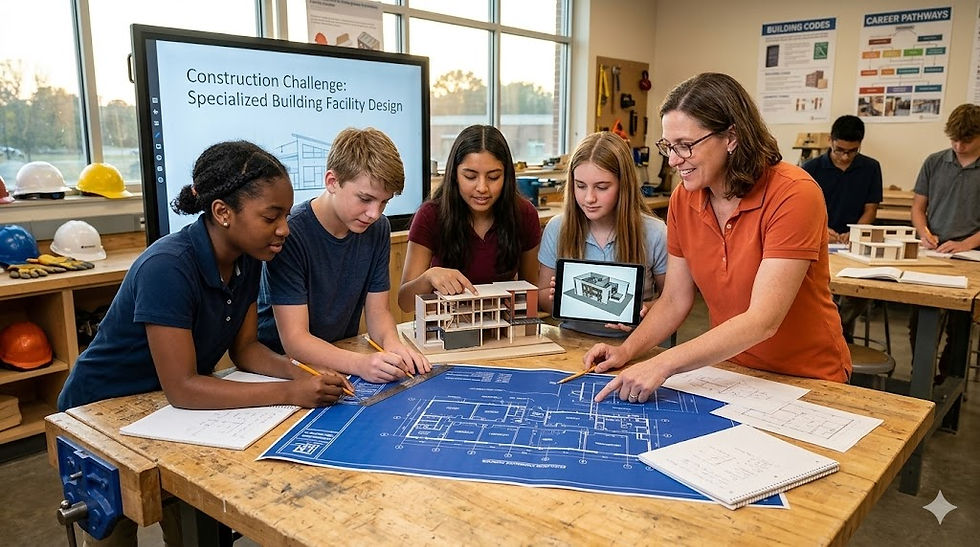
Industry-sponsored projects flip the traditional model on its head. Instead of sending students out to employers one by one, authentic workplace challenges come into the classroom where teachers can facilitate learning for groups of students.
Here's how it works:
A company identifies a real business challenge, something they genuinely need solved. They partner with schools to present that challenge to students in a relevant CTE pathway or course. Students work in teams to develop solutions over several weeks, applying classroom concepts to authentic problems. The company provides feedback throughout and reviews final presentations.
Example challenges from industry partners:
Manufacturing: Design a specialized carrier for inspecting delicate semiconductor wafers without damaging them (requires precision engineering, 3D modeling, understanding of tolerances and materials)
Construction: Create facility designs for specialized buildings (requires structural planning, electrical systems knowledge, safety considerations, professional documentation)
Other pathways: Healthcare workflow optimization, business plan development, marketing campaign creation, sustainability solutions, the possibilities span every career cluster
The key difference? One project reaches 30-50 students. The learning happens in the classroom, facilitated by a teacher. Every student participates, regardless of whether they have a car, professional clothes, or family connections.
Why This Matters for Equity
When work-based learning happens in the classroom, barriers disappear:
No transportation needed. Students don't need cars or parents who can drive them. They show up to school like any other day.
No schedule conflicts. Projects fit into existing class periods. Students with after-school jobs or family responsibilities can fully participate.
No professional network required. Access doesn't depend on who your family knows or which neighborhoods you live in.
No confidence gap. Students work in teams with teacher support, building professional skills gradually rather than being thrown into unfamiliar environments alone.
No financial burden. Families don't bear hidden costs (gas, professional clothes, unpaid time).
This isn't about lowering standards; it's about removing barriers that have nothing to do with a student's potential.
What Students Actually Experience
When students engage with industry-sponsored projects, they're not doing simplified "classroom versions" of real work. They're solving real business challenges that companies care about.
Students participating in work-based learning activities through CCL MARKETPLACE consistently report:
Discovering careers they didn't know existed
Gaining confidence in their ability to tackle complex problems
Understanding what specific careers actually involve (not just what they sound like)
Receiving valuable professional feedback from industry experts
Developing tangible work products they can showcase in portfolios
One student put it simply: "I was surprised about how open people were to teaching us all of the little things in business."
That authentic connection with professionals? It happens even when students aren't physically at a worksite. Virtual meetings, project feedback, and final presentations create real mentorship relationships, just in a more accessible format.
The Math That Makes It Possible
Let's look at what it takes to serve 300 students with quality work-based learning:
Traditional Approach:
Find 300 individual placements (employers, schedules, supervision)
Coordinate transportation for students who need it
Track 300 separate experiences
Reality: Most districts reach 30-40% of students due to logistics
Industry-Sponsored Projects Approach:
Deploy 6-8 projects across different pathways
Each project serves 30-50 students in a classroom setting
Reach 180-400 students with manageable coordination
Every student participates regardless of personal circumstances
The efficiency gain isn't just about saving coordinator time; it's about making equity achievable. When you're not limited by transportation logistics and individual placement coordination, you can actually reach every student.
When States Invest in Career Readiness
Across the country, states are recognizing that career exploration isn't optional; it's essential for student success. Many are creating funding mechanisms to support work-based learning programs.
Colorado, for example, recently passed legislation that creates funding for districts to help students achieve career readiness milestones through pathways such as work-based learning, industry credentials, or college credit. Similar initiatives are emerging nationwide, reflecting a growing understanding that authentic career exploration benefits students and strengthens regional talent pipelines.
When states invest in these programs, districts face a practical question: How do we maximize impact with available resources?
Industry-sponsored projects provide an answer. By serving more students per employer partnership and making experiences accessible to everyone, districts can make the most of funding opportunities while staying true to their equity commitments.
How It Works in Practice
The Business & Education Alliance (BEA) built industry-sponsored projects into the CCL MARKETPLACE platform specifically to make implementation straightforward:
For Teachers:
Browse curated projects aligned with your pathway or course
Access complete implementation guides and resources
Facilitate student work
Connect students with industry professionals for feedback
For Students:
Work on authentic challenges during class time
Collaborate in teams with teacher support
Present solutions to real company representatives
Build portfolios showcasing tangible accomplishments
For Districts:
Expand work-based learning access without expanding coordinator workload
Serve students who face barriers to traditional internships
Track participation and outcomes through the CCL MARKETPLACE platform reporting
Build sustainable industry partnerships that scale
Since 2020, students across Colorado have participated in industry-sponsored projects, gaining hands-on experience in engineering, construction, manufacturing, and other high-demand fields, all within their classroom settings.
Beyond One-Time Experiences
Industry-sponsored projects offer something else traditional internships often can't: iteration and depth.
Because projects happen in classrooms over several weeks, students can:
Receive feedback and improve their work (just like real professionals do)
Learn from mistakes without high-stakes consequences
Develop deeper understanding through multiple touchpoints with industry partners
Build skills progressively with teacher scaffolding
A one-day job shadow provides valuable exposure. But a four-week project where students tackle a real challenge, receive professional feedback, revise their approach, and present final solutions? That's transformative learning.
And it's accessible to every student in the classroom, not just the few who can navigate traditional placement logistics.
What This Means for Your District
Maybe you're already doing great work with traditional internships and want to expand access. Maybe you're just starting to build work-based learning capacity. Maybe you're somewhere in between.
Industry-sponsored projects work in all of these scenarios because they're designed to complement, not replace, existing efforts:
Strong WBL programs use ISPs to reach more students with existing coordinator capacity
Emerging programs use ISPs as accessible entry points while building employer relationships
Resource-constrained programs use ISPs to deliver quality experiences without intensive logistics
The common thread? Making career exploration accessible to every student, not just some students.
Getting Started
If you're already a CCL MARKETPLACE partner, industry-sponsored projects are available through your subscription. Log in and explore what's currently offered in your pathways.
If you're not yet connected with BEA, we'd love to have a conversation about your district's context:
What does your current career exploration landscape look like?
Which students are you reaching well, and which are falling through gaps?
What would it mean for your students if every single one had authentic career exploration?
What resources and capacity do you have to work with?
From there, we can explore whether industry-sponsored projects fit your needs, which platform tier makes sense, and how we can support your implementation.
This isn't a sales pitch; it's an invitation to explore possibilities together.
Let's Connect
Schedule a conversation: Whether you want a platform demo, have questions about implementation, or just want to brainstorm about expanding access in your district, we're here.
Prefer to start with email? Reach out to theresak@businessandeducationalliance.org
Industry partners: If your company has authentic challenges that could become student projects, let's talk. This is talent pipeline development that actually works, and it provides meaningful learning experiences for students who might not otherwise access your industry.
The Bigger Picture
At BEA, we believe every student deserves to explore careers authentically before making high-stakes postsecondary decisions. Not just students with built-in advantages. Not just students in certain programs. Every student.
Industry-sponsored projects are one tool for making that vision real. They're not perfect, and they're not the only answer. But they're proving that accessible, equitable, authentic career exploration isn't just an ideal; it's achievable.
What would it mean for your students if career exploration was truly accessible to all of them?
Let's find out together.
About the Author: Theresa Klinitski is Executive Director and Co-Founder of the Business & Education Alliance, a Colorado nonprofit dedicated to making career-connected learning accessible to every student. Since 2020, BEA has facilitated over 50,000 connections between students and industry professionals across 25+ school districts.


Comments